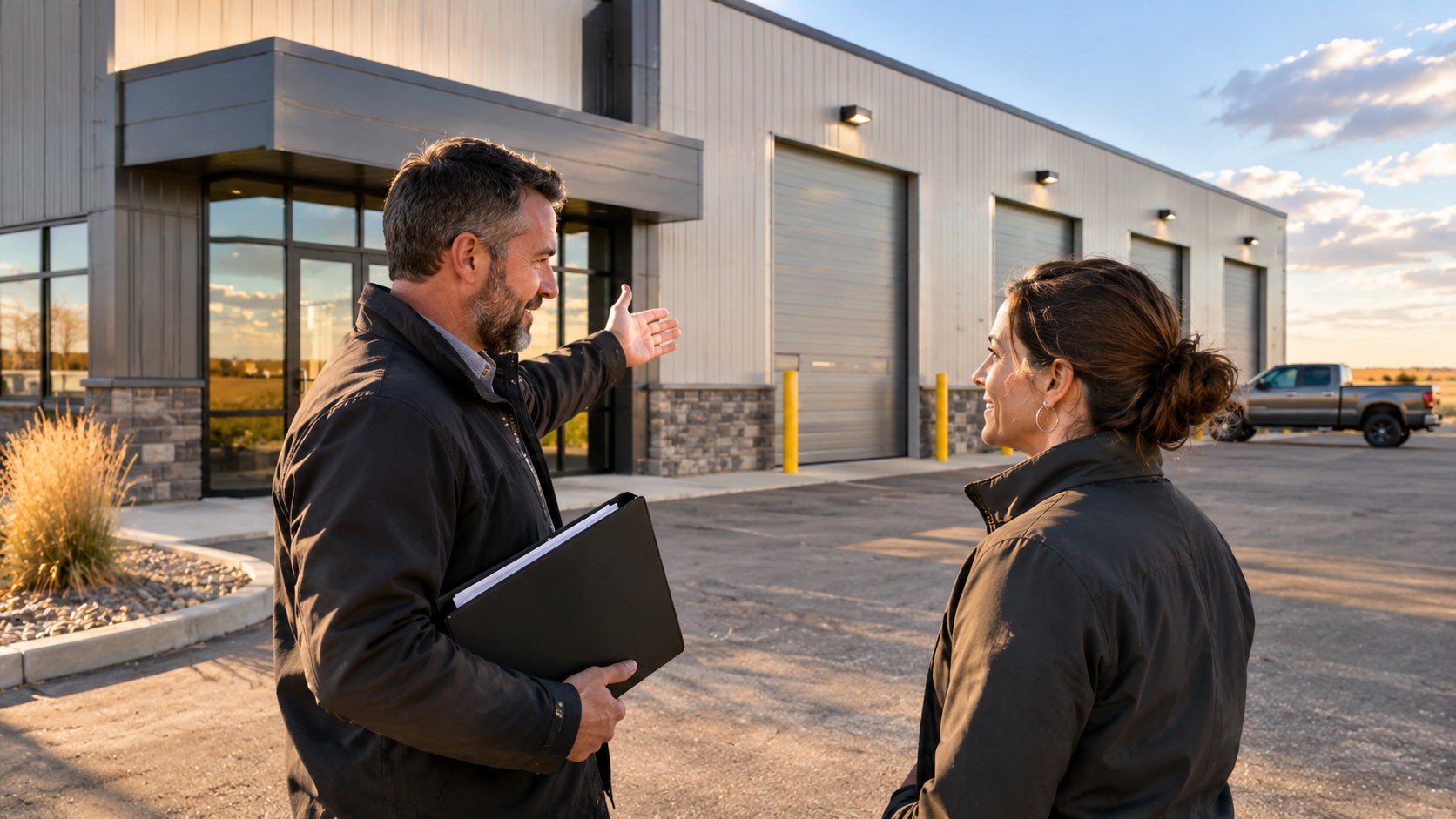
Buying the building, bay, or unit where your business operates is a different decision than leasing more space. It brings a different set of questions, a different due-diligence process, and a different set of professionals into the conversation.
Airdrie has a growing commercial and industrial base — with significant land supply in active development. The City has identified more than 375 acres of industrial land and 100 acres of commercial and mixed-use land with community area structure plans and immediate servicing. That means real options exist, across a range of property types, for businesses looking to own their space.
But owning is not automatically the right move for every business at every stage. And the due diligence on a commercial purchase is meaningfully more involved than a residential one.
Here are eight questions worth working through before you write an offer.
1. Is Ownership the Right Question for Your Business Right Now?
Before you evaluate any specific property, it's worth being honest about the strategic question: does owning commercial property make sense for your business at this stage?
Ownership has potential advantages — control over your space, no landlord, building equity, and stability of occupancy. But it also ties up capital, adds responsibilities for building maintenance and capital costs, and creates a fixed commitment to a location. If the business is still finding its operational shape, or if growth may require a different type or size of space in a few years, a purchase can constrain flexibility in ways a lease wouldn't.
This is a conversation to have with your accountant and your business advisors before you start evaluating properties. Not because ownership is the wrong answer — it's right for a lot of businesses — but because the answer should come from your business situation, not from the excitement of a specific listing.
2. Does the Property Allow What Your Business Actually Does?
This is the most important due-diligence question, and it needs to be verified — not assumed.
RECA's guidance for commercial buyers specifically highlights zoning and land-use restrictions as a key matter to address with a commercial licensee. A property that looks right on paper may be in a land-use district that doesn't permit your specific business activity.
Before you go further on any commercial property in Airdrie, verify:
- Zoning and permitted use. The land use district for the property determines what activities are permitted. A business in a general commercial district has different permitted uses than one in an industrial business district. Confirm with the City of Airdrie's planning department that your intended use is permitted — and get it in writing.
- Parking. Commercial properties have required parking ratios that vary by use type. If the parking available doesn't meet the regulatory requirement for your use, that's a problem. Verify the parking situation against the City's requirements, not just what the current owner uses.
- Licensing and operations. Does your business require any municipal or provincial licences tied to the location? Confirm those can be obtained at this address.
- Signage. What signage is permitted for the property and the district? If visibility is important to your business, confirm what's actually allowed before you count on it.
3. Does the Physical Space Work for Your Business?
A commercial property that is legally permitted for your use still has to physically work. This is a practical assessment that goes beyond the floor plan.
Think through:
- Loading and delivery. Does the property have the loading access your operation requires — grade-level doors, a dock, or room to manoeuvre a delivery vehicle? What works now, and what would need to change?
- Power and utilities. What electrical service does the building have? If your operation requires industrial power, is it already there? What would an upgrade cost?
- Ceiling height. For warehouse or production uses, clearance matters. Confirm actual usable height, not just nominal height.
- Customer access. If clients come to your location, how does the property handle that? Reception area, parking, visibility from the street, accessibility?
- Storage. How much of the space is genuinely usable for your intended purpose versus mechanical rooms, common areas, washrooms, or other fixed areas?
- Growth. If you add staff in the next two or three years, does the space still work? Is there room to reconfigure, expand, or absorb growth?
4. What Are You Buying — or Inheriting?
Beyond the physical space, a commercial property purchase comes with details that need to be understood before you commit.
- Property condition. A commercial property inspection should cover structure, roof, HVAC, electrical, plumbing, and any systems specific to how the building has been used. Older buildings may have deferred maintenance that isn't obvious from a walk-through. Know what you're taking on.
- Condominium documents. If you're buying a commercial condominium unit — a bay in a flex complex or a unit in an office building — there are condominium documents to review: bylaws, reserve fund study, financial statements, minutes, and any outstanding special assessments. Your lawyer reviews these. Read what they find.
- Existing service contracts. Are there contracts in place for maintenance, security, waste removal, or other services? What carries over to the new owner, and what can be changed?
- Tenant matters. If any part of the property is currently leased to a tenant, what are the terms? When does the lease expire? What are the obligations to the tenant, and how does that affect your plans for the space?
- Environmental considerations. For industrial properties in particular, the history of use on the site matters. Has the property been used for activities that may have resulted in soil or groundwater contamination? An environmental site assessment is standard due diligence for many commercial purchases. Your lawyer and lender will advise on whether one is required for the specific property.
5. What Will This Actually Cost?
The purchase price is one number. The total cost of owning this property is a different number, and it's worth building a realistic picture before you commit.
Beyond the purchase price, work through:
- Financing. Commercial mortgages have different terms than residential ones — typically a shorter amortization, a larger required down payment, and rates that reflect commercial risk. Talk to your lender or mortgage broker early. Understand what you can finance, at what terms, and what the monthly debt service actually looks like for your business.
- Legal costs. Commercial transactions involve more legal work than residential ones — title searches, document review, due diligence on zoning and permits, lease review if applicable, and the purchase contract itself. Budget accordingly.
- Land title transfer fees and taxes. Alberta does not have a provincial land transfer tax, but there are Land Titles fees on the title transfer and mortgage registration. GST may apply to a commercial property purchase depending on the circumstances — your lawyer and accountant will advise.
- Operating costs. Property taxes, building insurance, utilities, maintenance, and any condo fees or common-area costs. These are real ongoing costs that affect whether the ownership equation makes sense for your business.
- Renovations and fit-up. What does the space need to be ready for your operation? If the answer is "significant work," factor that cost — and the timeline — into your thinking.
6. What Could Affect Your Business Here in the Future?
A property that works well today may face changes around it. Part of buying commercial property is thinking ahead.
- Access. How is the property accessed, and is that likely to change? Road improvements, new signals, or changes to traffic patterns can all affect how easy it is for customers or suppliers to get to you.
- Neighbourhood development. What is planned or underway in the area? The City of Airdrie has significant commercial and industrial land under active development. What gets built around you matters — for better (more activity, more customers nearby) or in ways that require adjustment (more traffic, more competition for parking).
- Site constraints. Are there easements, rights-of-way, or other registered interests that limit what you can do with the property? Your lawyer reviews these in a title search.
- Business needs. Does the property still make sense if your business grows significantly, or if it needs to change? Owning a property that doesn't grow with you can become a constraint rather than an asset.
7. Who Should Review What?
A commercial property purchase involves a team of professionals, and each one handles a specific part of the picture.
- A commercial REALTOR®. A REALTOR® with commercial experience in Airdrie can help you identify suitable properties, understand the market, compare options, and negotiate on your behalf. Commercial buyer representation is typically at no direct cost to you — the seller covers the brokerage fee.
- A real estate lawyer. Reviews the purchase contract, title, zoning confirmation, condominium documents if applicable, and any other legal aspects of the transaction. Essential before you waive conditions.
- Your accountant. The purchase has tax and financial implications — for the business, for the ownership structure, and potentially for GST. Your accountant should be part of the conversation before you commit.
- A commercial lender or mortgage broker. Understand what financing is available, at what terms, and what the lender will require in terms of due diligence before they'll commit to funding the purchase.
- A qualified inspector. A commercial property inspection is not the same as a residential home inspection. Make sure the inspector has experience with the type of property you're buying.
- Environmental consultant if applicable. For industrial properties or sites with a history of certain uses, an environmental site assessment is standard. Your lawyer and lender will advise.
8. How to Make an Offer With a Coherent Due-Diligence Plan
A commercial purchase offer will typically include conditions that give you the opportunity to complete due diligence before you're bound by the purchase. These conditions are your protection.
Standard due-diligence conditions in a commercial purchase often include:
- Financing condition — time to confirm your financing is approved on acceptable terms
- Inspection condition — time to complete a building inspection and review the findings
- Title review — time for your lawyer to review title and all registered interests
- Zoning confirmation — time to confirm with the City that your intended use is permitted
- Document review (if condo) — time to review condominium documents
- Environmental review if applicable
Work with your commercial REALTOR® and lawyer to make sure the conditions in your offer give you enough time to actually complete each step. Rushing due diligence on a commercial purchase is one of the more expensive mistakes a buyer can make.
Going into an offer with a clear plan for what gets reviewed, in what order, by whom, and in what timeframe makes the process significantly more manageable — and puts you in a better position if you find something that needs to be addressed.
This post is general guidance for business owners considering a commercial property purchase in Airdrie. Legal, tax, accounting, financing, environmental, building-condition, zoning, and permit matters are specific to each property and business and require qualified professionals and municipal confirmation. Nothing in this post constitutes legal, tax, or financial advice.
Andre can help you identify the property, site-selection, and due-diligence questions before you write an offer.
Ask Andre