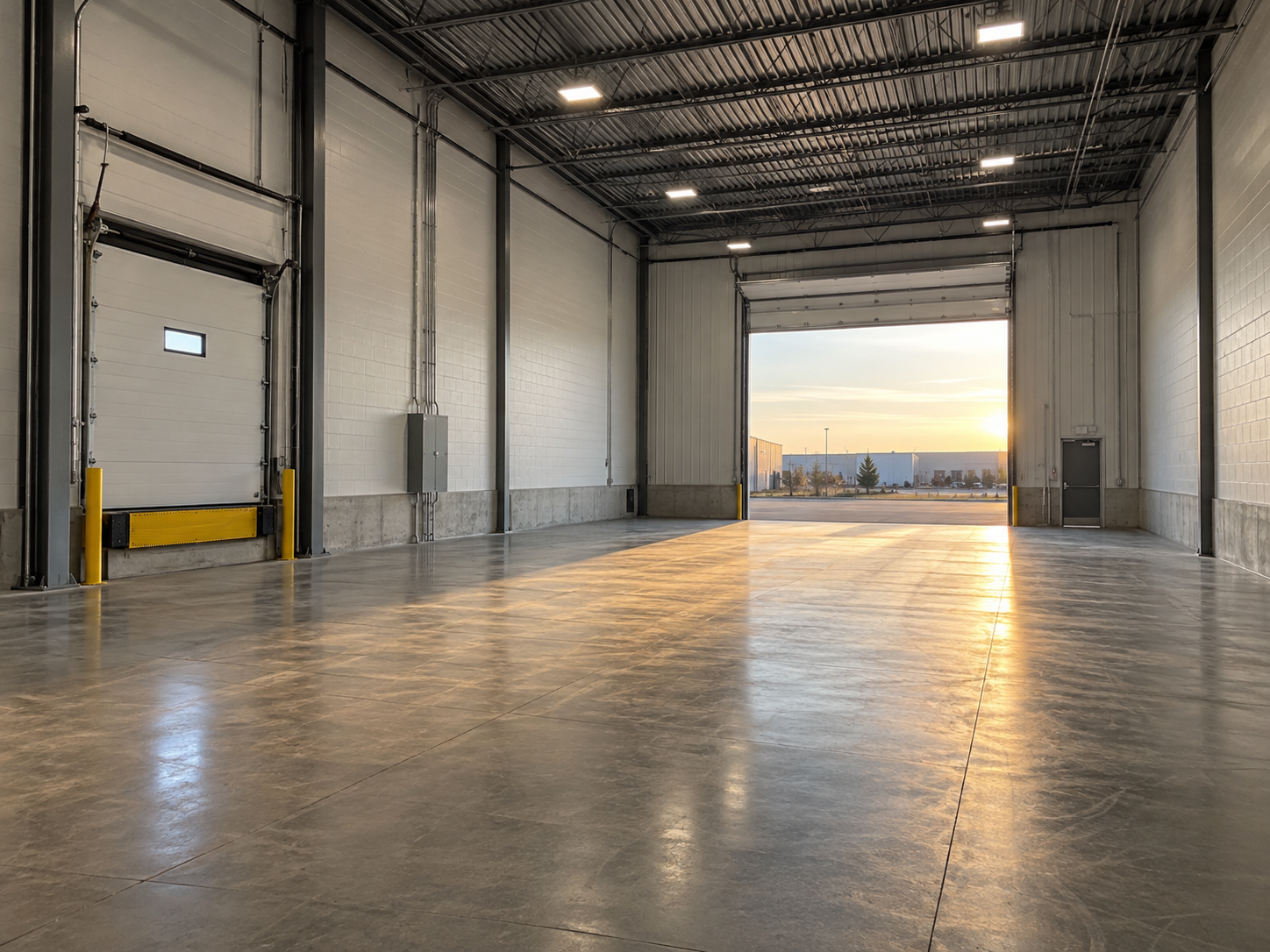
Airdrie's industrial market is one of the tightest in Alberta right now. Vacancy is sitting under three percent across the greater Calgary region, and Airdrie specifically is drawing businesses away from Calgary's higher-cost industrial corridors. If you're a business owner looking for warehouse, flex, or light industrial space in Airdrie in 2026, you're operating in a landlord's market — and knowing what you're looking for before you start touring spaces will save you time, money, and mistakes.
The Market in Numbers
That vacancy number tells you everything you need to know about your negotiating position as a tenant: it's tight. Good units don't sit. Businesses that are slow to decide lose space to faster-moving competitors. That said, Airdrie still offers a genuine cost advantage over Calgary's primary industrial nodes — lower rates, lower land costs, and less congestion — which is why businesses from across the region continue to look here first.
Why Airdrie for Industrial Space
The case for Airdrie comes down to three things: Highway 2 access, cost, and land availability.
Highway 2 runs directly through Airdrie and connects north to Red Deer and Edmonton, south to Calgary's ring road network. For distribution, logistics, trades, and any business that moves product, that access is the primary draw. Most of Airdrie's industrial land — concentrated in the East Lake Industrial area, Veterans Boulevard, and the newer Balzac-adjacent zones — sits within minutes of a Highway 2 on-ramp.
On cost, Airdrie industrial lease rates typically run 10 to 20 percent below comparable Calgary submarkets. The gap has narrowed as demand has grown, but it persists — particularly for smaller bays in the 2,000 to 5,000 square foot range that are in short supply everywhere.
On availability, Airdrie has over 375 acres of serviced industrial land — more room to absorb new development than many Calgary submarkets. Several new industrial projects have delivered or are under construction in 2025–2026, which provides some relief. But pre-leasing rates on new construction have been high — meaning much of that new supply was spoken for before it opened.
What to Evaluate Before You Sign
Understanding Industrial Lease Structure
Industrial leases work differently from residential or retail leases. Understanding the terminology before you sit across from a landlord is important.
| Term | What It Means for You |
|---|---|
| Net Rent / Base Rent | The core rent per square foot per year, before operating costs. This is the headline number in listings — always ask what the total occupancy cost is on top of it. |
| Operating Costs (Opex) | Property taxes, building insurance, common area maintenance, and property management fees — passed through to tenants on a pro-rata basis. Can add $3–$6/sq. ft. to your base rent. |
| Triple Net (NNN) | You pay base rent plus all operating costs plus your own utilities. Most common structure for industrial in Alberta. |
| Tenant Improvement (TI) Allowance | Money the landlord provides to build out the space to your requirements. In a tight market, TI is negotiable — landlords want good long-term tenants and may contribute more for a 5-year commitment than a 2-year one. |
| Renewal Option | Your right to renew the lease at the end of the term, typically at market rate or a defined cap. Negotiate this into the original lease — don't assume it. |
| Free Rent Period | Months at the start of a lease where you pay no rent while building out the space. Common in new construction and worth negotiating in established buildings if significant TI is required. |
| Personal Guarantee | Many landlords require principals of smaller businesses to personally guarantee the lease. Understand what you're signing — it means your personal assets are on the line if the business can't pay. |
What You Can Negotiate in This Market
A sub-3% vacancy market doesn't mean you have no leverage — it means you have less of it. Here's where tenants can still move the needle:
TI allowance. If you're committing to a longer term, landlords in Airdrie are still contributing toward tenant improvements — particularly electrical upgrades, office buildout, and HVAC modifications. The stronger your business covenant (good financials, established operation), the more a landlord will invest in you.
Free rent. Even in a tight market, a month or two of free rent at the start of a lease while you're building out and moving in is a reasonable ask. Frame it as an operational necessity rather than a negotiating tactic.
Renewal terms. This is where the real long-term value is. Negotiating a renewal option with a defined rate cap — say, market rate not to exceed a 10% increase — protects you from an aggressive rent reset at the end of your term. Get this in writing from day one.
Assignment and subletting rights. If your business grows and you need to move, or if circumstances change, the ability to assign your lease to another tenant or sublet part of your space is valuable. Negotiate this into the lease rather than discovering you can't do it when you need to.
The Airdrie Industrial Areas Worth Knowing
East Lake Industrial: Airdrie's most established industrial node, running along the east side of the city. Mix of older and newer product. Direct access to Veterans Boulevard and Highway 2. Home to a wide range of trades, service businesses, and light manufacturing tenants. Most of Airdrie's existing industrial inventory is here.
Veterans Boulevard corridor: Newer development along Veterans Boulevard has added quality modern product — higher clear heights, dock-high loading, better power capacity. Slightly higher rates than older East Lake product but more appropriate for distribution and logistics operations.
Balzac / north Calgary fringe: Cross County Industrial and the broader Balzac node sits just south of Airdrie's boundaries. Technically Rocky View County rather than City of Airdrie, which has some zoning and development levy implications — but the Highway 2 access is equally strong and some businesses find more availability here than in Airdrie proper.
Andre works with businesses across Airdrie's commercial and industrial market — from trades contractors needing their first bay to growing distribution operations needing multiple units. If you're evaluating space or want to understand what's actually available before the best units are gone, reach out.
Ask Andre