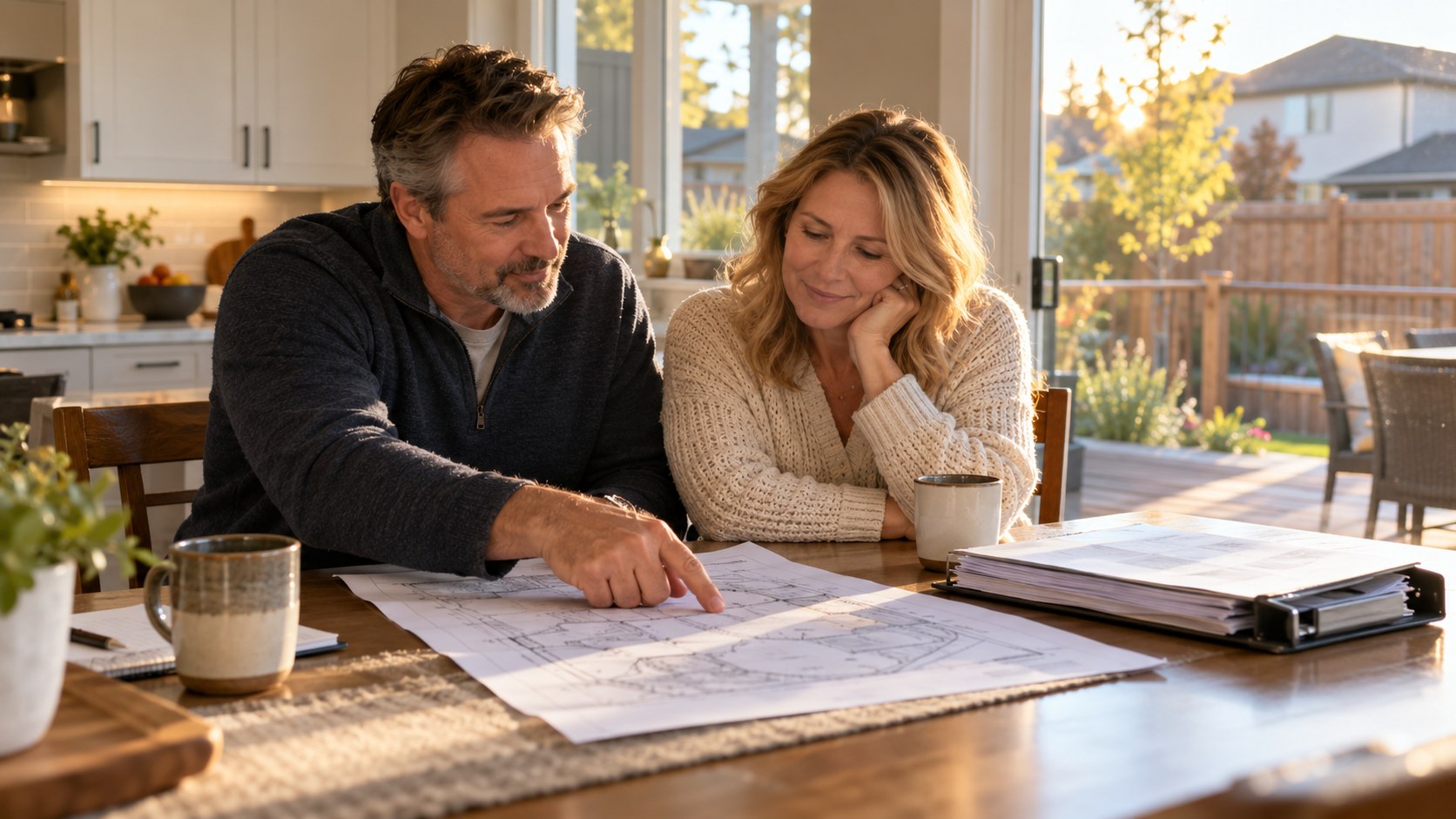
If you're getting ready to sell your Airdrie home, one of the first documents that will likely come up is the Real Property Report. It's one of the more misunderstood parts of a property sale — buyers hear the term, sellers scramble to find an old copy, and transactions sometimes slow down because no one addressed it early.
This post is a plain-language walk through what an RPR is, what a certificate of compliance adds to it, how title insurance relates to both, and what to pull together before you go live.
What Is a Real Property Report?
A Real Property Report is a legal document prepared by an Alberta Land Surveyor. It shows the property boundaries and the location of visible improvements — buildings, garages, decks, fences, sheds — relative to those boundaries.
The Alberta Land Surveyors' Association describes it as a plan drawn from an on-site survey, showing the property as it currently exists. It is not a home inspection and it does not assess condition. It shows location.
Because it reflects physical reality at a specific point in time, an RPR becomes outdated when anything visible changes. If a deck was added after the last survey, or a fence moved, the old report no longer accurately represents the property.
What It Typically Shows
An RPR prepared for an Airdrie property will typically identify:
- Property boundaries.
- The location of the home, garage, and any outbuildings.
- Structures like decks, fences, and sheds.
- Easements and right-of-ways that are visible or registered.
- Any apparent encroachments — where a structure may cross a property line or encroach on an easement.
What it does not show: condition of structures, underground systems, or anything not visible from the surface.
Why Sellers Should Look for It Before Listing
The time to think about your RPR is before you list, not after you have a buyer.
Here's why timing matters. Once you're in a transaction, everything moves faster. If your RPR is out of date — because a deck was built, a fence replaced, or a garage added since the last survey — you'll need a new one or an update. Getting that survey scheduled, completed, and reviewed takes time. Add the City of Airdrie's review process on top of that, and you're looking at a delay that can affect your closing timeline.
The City of Airdrie notes that an RPR is often requested during a property sale. Checking for one early gives you the chance to deal with questions on your schedule, not the buyer's.
A few questions worth asking before you list:
- Do you have an existing RPR? When was it prepared?
- Has anything visible changed since then — a deck, fence, shed, or garage?
- Are there any structures you're not sure were permitted?
What a Certificate of Compliance Is
A certificate of compliance is separate from the RPR. The City of Airdrie issues it after reviewing the RPR against the Land Use Bylaw. It confirms — or identifies exceptions to — whether the visible improvements on the property comply with the bylaw.
A few points worth understanding:
- The certificate is issued by the City, not the surveyor. The surveyor produces the RPR; the City issues the certificate.
- Compliance review takes time. The City's timeline depends on current workload; sellers who leave this late in a transaction can find themselves under pressure.
- If an improvement doesn't comply with the Land Use Bylaw, the certificate will note it. How that affects the transaction depends on the situation and is a question for your real estate lawyer.
RPR Versus Title Insurance
These two things are not interchangeable, and they address different questions.
An RPR and certificate of compliance address the physical property — where structures are, whether they comply with the bylaw. Title insurance is a policy that protects the insured against certain title-related risks, which can include things that an RPR might identify, such as encroachments or survey issues.
In some transactions, buyers choose title insurance as an alternative to requiring an updated RPR. In others, an updated RPR and certificate of compliance are still required. The right approach depends on the specific property, the parties involved, and what their lawyers advise.
This is not a decision to make based on a blog post. It is a conversation to have with your real estate lawyer and, where relevant, an Alberta Land Surveyor.
A Simple Pre-Listing Document Checklist
Before you meet with a REALTOR® to discuss listing, it helps to know where you stand on these:
- Prior Real Property Report. Do you have one? Pull it out and check the date and what structures are shown. Has anything changed since it was prepared?
- Building permits. If improvements were made to the property — a deck, basement development, garage, fence — were permits pulled and closed? Permit records are worth gathering. Your REALTOR® and lawyer will want to know the status.
- Property documents. Title, survey, utility documents — gather what you have. Some of this your lawyer will search independently, but having your own copies available speeds things up.
- Questions to raise early. If there's anything about the property you're unsure about — a structure whose permit status is unclear, a fence that might be on a property line, an older addition — flag it at the start. Early is almost always better than mid-transaction.
This post provides general information about real property reports and certificates of compliance in Airdrie. Every property and transaction is different. Questions about your specific RPR, compliance status, title, or transaction should be directed to an Alberta Land Surveyor, a real estate lawyer, and your REALTOR®.
Ask Andre for a pre-listing conversation that helps identify the property documents and professional questions to address before you go live.
Ask Andre