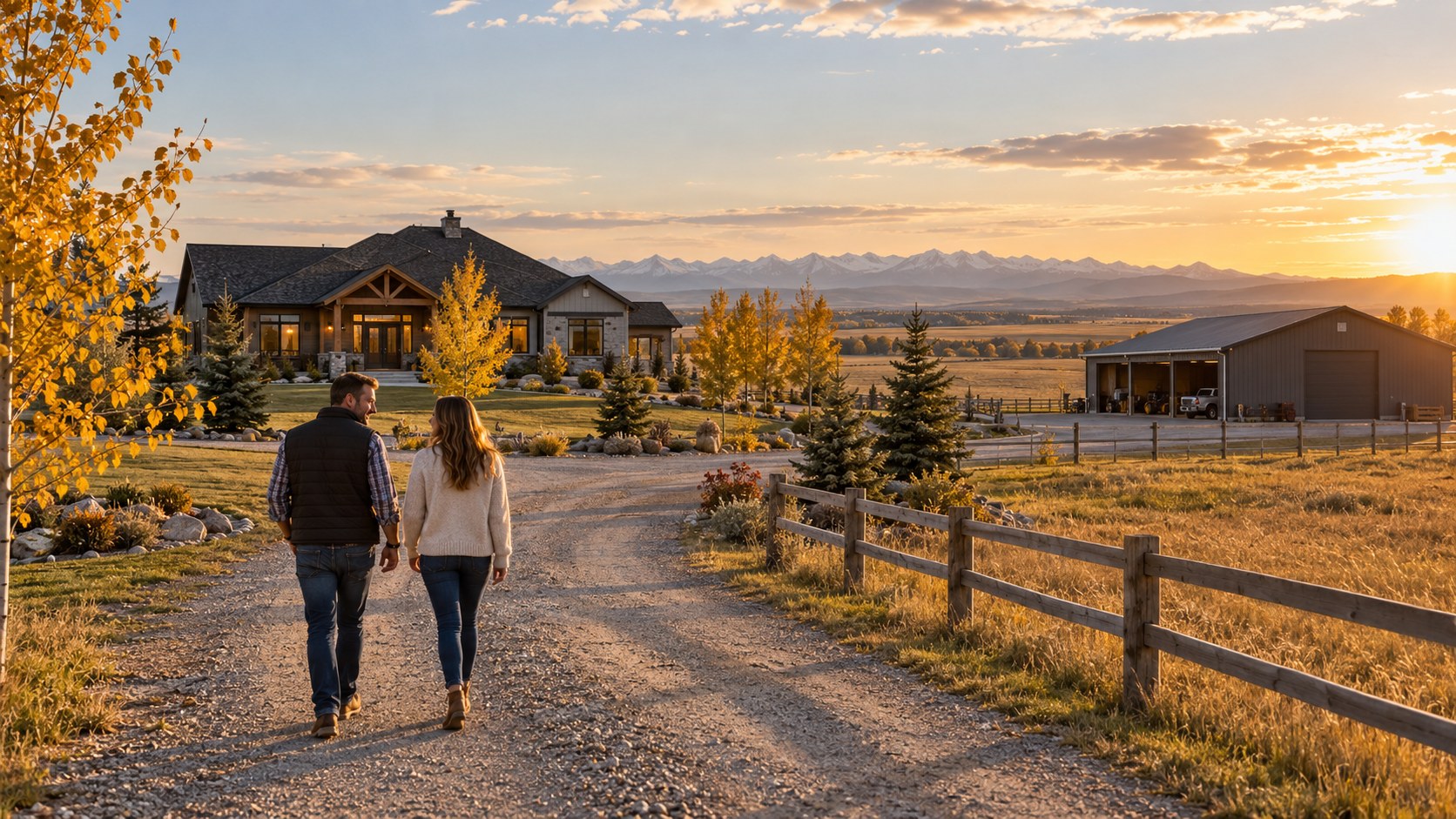
An acreage near Airdrie checks a lot of boxes. More space, privacy, room for animals or outbuildings, and you're still close to town. But an acreage is not simply a city house with a larger yard. The systems, services, and responsibilities that come with rural property are different from what most buyers are used to — and understanding them before you offer is a lot easier than discovering them after.
Here are ten questions to work through before you commit to a rural property near Airdrie.
What's Different About Owning an Acreage
When you own a home in Airdrie, the city handles water supply, wastewater removal, road maintenance, garbage pickup, and emergency services access. On an acreage, many of those responsibilities shift to you.
Your water comes from a private well you own and maintain. Your wastewater goes into a septic system on your property. The road to your door may or may not be maintained by the county in winter. Your garbage may need to be driven to a transfer station. Your internet options may be limited. None of this is a dealbreaker — plenty of people live on acreages happily for decades. But these are real differences that affect your operating costs and daily life, and they vary significantly from one property to the next.
Rocky View County, which surrounds much of Airdrie, maintains rural living information for residents new to acreage ownership, and it's worth reviewing before you search. Understanding the county's approach to road maintenance, land use bylaws, and rural services helps you ask better questions when you're looking at specific properties.
Questions About Water
1. What is the water source, and where are the well records?
Most acreages near Airdrie rely on a drilled private well. In Alberta, licensed water well drillers are required to file well records with the province — the Alberta Water Well Information Database (AWWID) is publicly searchable and shows depth, construction date, static water level, and yield at the time of drilling.
Ask for the existing well records. If the seller doesn't have them, search AWWID with the legal land description. Understand how old the well is, how deep it goes, and what yield the driller recorded. A well specialist or licensed water professional can review those records and tell you what questions to ask next.
2. Has the water been tested recently, and what did the test show?
Private well owners are responsible for managing and maintaining their wells, including water testing. Alberta Environment and Protected Areas recommends testing private well water at least once a year for bacteria, and periodic testing for other parameters depending on local conditions.
Ask for copies of recent water test results. Find out what was tested, when, and what the results showed. If tests haven't been done recently, arrange for an independent water test before you waive your inspection condition. A water test is a low-cost step that tells you a lot about what you're buying.
3. Is there any water treatment equipment, and what does it address?
Many rural properties have water treatment systems — softeners, UV systems, reverse osmosis units, iron filters. Ask what treatment equipment exists, how old it is, when it was last serviced, and importantly, what problem it's solving. Treatment equipment is not a red flag, but understanding why it's there and whether it's been maintained properly is useful information.
Questions About Septic
4. What type of septic system is on the property, and where are the records?
In Alberta, septic systems must be permitted and installed to provincial standards. Common system types include conventional tanks with field lines, holding tanks (which require regular pump-outs), and more advanced treatment systems. Each type has different maintenance requirements and operating costs.
Ask for the original permit, the installation records, and any maintenance history. Find out when the tank was last pumped. Ask whether the system has ever had issues, repairs, or alterations. If records are unavailable, a septic inspection by a qualified professional can assess the current condition and identify any concerns.
5. Has the septic system been inspected, and is it sized appropriately for the home?
A septic system's capacity is designed for a specific number of bedrooms or occupants. If the home has been expanded or the number of occupants has changed significantly, the system may be undersized for how the property is being used.
A qualified septic inspector can assess the condition of the tank, the distribution system, and the absorption field. This is a separate inspection from a standard home inspection, and it's worth having done before you commit.
Questions About Road Access
6. Who maintains the road in winter, and what does that actually mean?
This question matters more than most buyers expect. On a paved or maintained gravel road, Rocky View County or another municipality may handle snow clearing. On a private road or a road allowance, maintenance may fall to the property owner or a group of neighbouring landowners.
Find out what type of road access the property has, who is responsible for maintenance, and what the historical experience has been. Ask the seller directly how they've managed access in difficult winters. If there's a shared access road with neighbours, ask whether there's a formal road maintenance agreement and what it covers.
7. Are there any easements or right-of-way issues affecting the property?
Acreages can have easements for utility corridors, pipeline right-of-ways, access roads for neighbouring properties, or other registered interests that limit what you can do on portions of your land. These show up in a title search.
Your lawyer will review the title and identify any registered encumbrances. Before you waive your conditions, make sure you understand what's on title and how it affects your intended use of the property.
Questions About Utilities and Services
8. What utilities and services are available, and what do they actually cost?
On an acreage, you may be dealing with:
- Natural gas or propane. Some rural properties near Airdrie have natural gas service. Others rely on propane, which requires a tank on the property and periodic fill-ups at market prices.
- Electricity. Most acreages have grid electricity, but the infrastructure and reliability can vary.
- Internet. This varies significantly by location. Some areas near Airdrie have access to fibre or fixed wireless; others are limited to satellite service. If reliable internet is important to you — for work or otherwise — confirm what's actually available at this specific address, not just in the general area.
- Garbage and recycling. Many rural properties require driving waste to a county transfer station. Find out where the nearest one is and what it costs.
- Emergency services. Response times for fire, ambulance, and police are longer in rural areas than in town. This is worth factoring into your insurance planning and general preparedness.
Ask about the cost and logistics of each of these before you make an offer. Operating costs on an acreage can be meaningfully higher than on a comparable city property.
Questions About Land Use
9. What does the land use bylaw permit on this property?
Rocky View County and other municipalities around Airdrie have land use bylaws that govern what you can do on a rural property. If you're planning to keep horses, run a home-based business, build additional outbuildings, or subdivide in the future, the permitted uses for this specific parcel matter a great deal.
Ask what land use district the property falls under and what that designation allows. Your REALTOR® or lawyer can help you access the relevant bylaw, and the county's planning department can answer questions about specific intended uses. Don't assume that because an acreage looks like the right property for your plans, the bylaw actually permits them.
10. Are there any existing non-conforming uses, outbuildings, or structures that may need attention?
Older acreages sometimes have structures — sheds, shops, barns, secondary suites — that were built without permits or that don't conform to current bylaws. These can create complications at resale, affect your insurance coverage, or require remediation.
Ask whether all structures on the property were permitted. Ask whether there are any known non-conformities. A building inspector and your lawyer can help identify anything that needs to be resolved before you're comfortable proceeding.
Before You Remove Your Conditions
On an acreage, the standard home inspection is a starting point — not the whole picture. Before you waive your conditions, you want:
- A water test and professional review of the well and water system
- A septic inspection by a qualified septic professional
- Confirmation of road access arrangements and any shared road agreements
- A title review by your lawyer, including all easements and encumbrances
- Clarity on permitted land uses for your intended purposes
These aren't obstacles. They're the information that lets you buy with confidence — or identify a problem early enough to walk away.
This article provides general guidance for buyers considering rural property in Alberta. Water quality, well condition, septic performance, land use, and compliance questions should be reviewed by qualified professionals. Consult a licensed home inspector, well specialist, septic inspector, real estate lawyer, and the relevant municipality for property-specific advice.
Andre can help you compare the property and location questions before you commit to a rural home search.
Ask Andre